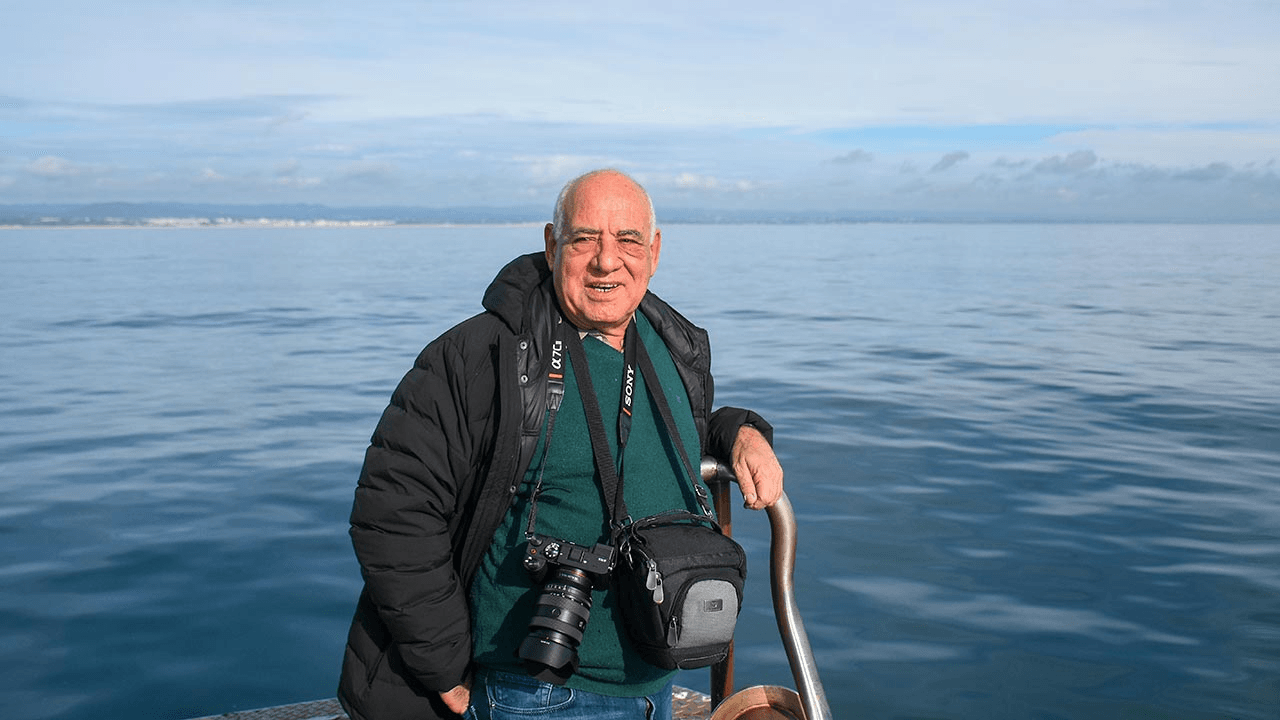
Building the Next Phase of Aquaculture: An Interview with Pedro Pousão from S2Aqua CoLAB
March 3, 2026
Pedro Pousão’s perspective, S2Aqua CoLAB
This interview was conducted with Pedro Pousão, IPMA Researcher and Chairman of the Board of S2AQUAcoLAB, as part of the Blue Compass project, promoted by the Hub Azul Portugal Network, based on insights from the Hub Azul Dealroom, the leading digital matchmaking platform for blue innovation.
From your perspective, what are currently the main scientific and technological innovations with the greatest potential to increase the sustainability of aquaculture?
I would highlight two major and highly significant developments. The first is the expansion of offshore aquaculture, meaning farming in open-sea cages. These systems require different technologies compared to coastal cages: specialized feeding systems, data transmission, surveillance tools, and even robots that operate between cages and monitor fish health. In countries such as Norway, cages are already operating in areas with strong waves and currents, achieving very high production levels.
The second major development is RAS (Recirculating Aquaculture Systems). These systems prevent the entry of contaminants, allow full control of incoming water, and maintain optimal temperatures without exposure to environmental fluctuations. This reduces environmental impact and enables higher production per cubic meter, with greater stocking densities and improved predictability.
In parallel, there has been significant progress in robotics and artificial intelligence, enabling increasingly precise control. Today, probes measure temperature, oxygen, and increasingly nutrients, toxic ammonia, and nitrites, generating automatic alerts. The integration of this data allows systems to be managed almost in real time.
What advancements do you consider most relevant in aquaculture nutrition and alternative ingredients, both from an environmental and production perspective?
Nutrition has evolved tremendously over the past years. Highly efficient feeds were first developed for trout and salmon, and that knowledge was later adapted to other species such as seabream and seabass, with increasingly tailored formulations.
A major shift has been the progressive replacement of fishmeal and fish oil, traditionally produced from dedicated fisheries, particularly in South America. Today, their use has been significantly reduced, not only due to limited availability but also because of environmental concerns.
This substitution is not straightforward — when replacing animal protein with plant protein, amino acid profiles must be carefully adjusted. Moreover, these marine sources cannot be completely eliminated, as we want farmed fish to remain a source of marine omega-3, which is essential for human nutrition. If these ingredients were entirely removed, supplementation would be required, which is not the objective.
There is also considerable misinformation, particularly regarding soy use. In many cases, what is used are by-products, such as the protein fraction remaining after oil extraction, rather than products intended directly for human consumption.
Another highly relevant development is the use of supplements and bioactive compounds, many derived from algae extracts, probiotics, and prebiotics. These help fish better resist disease, transport stress, and handling, improving animal welfare and supporting normal growth.
There is also the possibility of “fine-tuning” the final product by enriching feeds, for example with omega-3, selenium, or iodine in the final production stages, to meet specific nutritional needs of certain consumer groups.
A particularly important advancement is the integration of analytics and precision feeding. Systems can now calculate in real time how much feed should be delivered, how much fish actually consume, and what the feed conversion rate is. This allows automatic adjustment of feeding strategies, optimizing growth and reducing waste. This is especially relevant since feed represents around 40% of production costs and is also one of the main sources of pollution when poorly managed.
What technical, ecological, or knowledge transfer challenges still hinder the adoption of more sustainable practices in aquaculture?
In terms of knowledge transfer, aquaculture has an advantage: it is a relatively recent activity, with technically trained professionals, which facilitates the adoption of new practices.
Today, there are strict regulations and controls, requiring more rigorous management. For example, the use of antibiotics is often discussed, but this is largely a misconception. Antibiotics cannot be freely purchased — they must be prescribed by a veterinarian, recorded, and fish can only be sold after complying with mandatory withdrawal periods.
The major challenge remains public misinformation, often driven by videos or campaigns supported by other interests.
In Portugal, there is strong education and research capacity in this field — universities and research centers are deeply engaged in environmental components — and the message that aquaculture can be well controlled and sustainable is increasingly consolidated, although not always fully understood by all stakeholders.
Here, CoLABs play a fundamental role: they bridge industry and academia. Because they are largely industry-oriented, they ensure that research responds to real needs and that technology is effectively transferred to the field.
Looking ahead to the next 5 to 10 years, what structural changes or priorities do you consider essential to ensure the sustainability and viability of aquaculture?
In Portugal, structural changes are absolutely urgent. A country that produces only around 3% of the fish it consumes and depends heavily on imports is in a very fragile position, particularly in terms of food security.
To develop offshore aquaculture, two essential conditions are required.
First, port and logistical infrastructure: ports, marinas, and land-based support areas. Many of these infrastructures are being diverted to other uses, which limits the sector’s development.
Second, sufficient land-based pre-growing capacity is essential. Portugal’s coastline is highly exposed, without protected areas such as fjords. It does not make sense to place very small fish directly offshore — they need to be raised on land until they reach a more robust size before being transferred to sea cages.
Additionally, the country needs genuine medium- and long-term planning: clearly defining which species to produce, where, and under what model. It is not enough to have strategy documents with numerical targets; effective spatial planning and prepared zones are required.
I also advocate for the creation of designated aquaculture industrial zones, already structured and equipped with baseline conditions, to attract investment and prevent projects from failing due to lack of proper framework.
Finally, alignment among public institutions is essential. Ambitious policy discourse is often followed by successive licensing bottlenecks, which ultimately delay projects and discourage investors.

Fórum Oceano is the managing entity of the Portuguese Sea Cluster, certified and recognised by the Ministry of Economy and the Sea, the Ministry of National Defence and the Ministry of Planning and Infrastructure.
With the support of

© 2026 Fórum Oceano. All rights reserved. Developed by Yacooba Labs