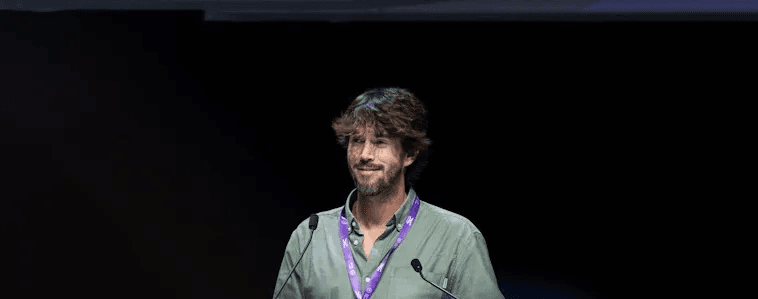
Redefining Aquaculture Production: An Interview with João Rito from SEAentia
February 9, 2026
João Rito’s perspective, Founding Partner of SEAentia
This conversation with João Rito, Founding Partner of SEAentia, was carried out within the framework of the Blue Compass project, an initiative of the Hub Azul Portugal Network, drawing on insights from the Hub Azul Dealroom — the leading digital platform connecting blue innovation stakeholders.
Based on SEAentia’s experience, what do you consider to be the most critical limitations of traditional aquaculture models, and how can technology help overcome them?
Conventional aquaculture models are essentially estuarine aquaculture and cage-based aquaculture.
The key point is this: we want — and will need — to produce more through aquaculture to meet global consumption. The challenge is to do so more responsibly, ensuring environmental and social sustainability, while producing intensively and respecting animal welfare.
This is where technology works in our favour: enabling increased production and the development of more projects, while reducing dependence on natural environmental conditions, which are becoming increasingly unpredictable. At the same time, we must guarantee biosecurity — ensuring that the fish are healthy and safe for consumption — and ensure that the entire process becomes progressively more sustainable, using fewer resources and replenishing them at a higher rate than they are consumed. All of this must be achieved without compromising animal welfare.
Traditional models, in general, cannot ensure all these dimensions simultaneously, even though they are widely used because they are less expensive. They rely heavily on environmental conditions, and it is difficult to guarantee full process control and animal welfare.
The technology that primarily addresses these challenges is the application of RAS (Recirculating Aquaculture Systems).
With RAS, production takes place in a controlled environment: it is not dependent on natural conditions, it uses limited water, ensures biosecurity, and generally offers improved sustainability. Animal welfare can also be better safeguarded, since fish are not exposed to adverse external conditions.
RAS is a scalable model and can be used for various species, such as meagre, salmon, and even flatfish like turbot. However, when cultivating a new species, it is essential to have a deep understanding of that species.
Some species are particularly challenging. Tuna, for example, cannot yet be effectively reproduced in captivity. In practice, juvenile fish are captured and then raised in cages, fed with fish by-products. Considering the size of tuna, this is an extremely demanding process.
Which technological innovations do you consider essential to enable aquaculture at industrial scale (e.g., structural design, automation, remote monitoring, integration with ocean energy)?
At a fundamental level, the question is: why are we not producing more? One major reason is that RAS remains expensive. Pumps, water circulation systems, heat pumps — these all contribute to high operational costs. If production is to increase, costs must decrease.
Improving energy efficiency is therefore a top priority. This includes enhancing the electronic components of RAS systems to reduce consumption and designing systems that rely more on gravity, thereby lowering energy use.
There is also a very practical production challenge: in a large tank — for example, 1,000 m³, comparable to an Olympic swimming pool — how can producers accurately determine the number of fish, their weight, and the true average biomass?
Currently, this is typically done through monthly sampling. However, this method is prone to error, requires significant labour, and is stressful and disruptive for the fish.
More advanced technologies are now emerging, such as underwater monitoring systems that allow continuous fish analysis. The challenge is that these technologies must be adapted to each species.
Such tools can detect stress events and identify, for example, when fish stop feeding. Automated systems could adjust feeding accordingly, reducing feed quantities when stress is detected.
Although similar technologies already exist in other sectors, aquaculture often lacks sufficient investment and requires stronger knowledge transfer.
Many challenges are also species-specific. For example, transferring fish from one tank to another is a genuine production hurdle and requires tailored solutions.
Another important issue is slaughter methods. Currently, fish are most commonly killed by asphyxiation or ice, which significantly affects product quality. Electrocution is considered one of the best alternatives, but it is not yet widely adopted and continues to be studied and refined.
Ikegime, a technique used in Japan, is also recognised for its quality benefits, but there is not yet an established technological solution that allows its industrial-scale implementation.
Data management and traceability represent another key area. There are European initiatives, such as Sea2Sea, addressing these topics. At present, consumers typically know the country of origin and production method of fish, but not detailed information such as the producing company — and this level of transparency is not yet mandatory.
Technologies such as blockchain could play a role here.
There is also potential for data monetisation. For example, measuring stress indicators such as cortisol levels in fish could provide valuable insights into animal welfare, with significant practical applications.
What technical, regulatory, or investment challenges continue to limit the large-scale adoption of offshore solutions?
One of the main barriers remains cost, as well as the need for highly efficient technology to ensure animal welfare and proper monitoring. Offshore aquaculture may be sustainable in theory, but in practice it remains heavily dependent on environmental conditions and requires further technological development and investment to become more controlled and scalable.
How do you see the evolution of the aquaculture sector over the next 5 to 10 years, in terms of production location, business models, and integration with other blue economy activities?
The sector is likely to move towards models that allow greater production with increased control, enhanced biosecurity, and improved sustainability. There will be a strong emphasis on technology — particularly RAS systems, digitalisation, automation, monitoring, and traceability.
Data will play an increasingly central role, not only in internal management but also in ensuring market transparency and traceability.

Fórum Oceano is the managing entity of the Portuguese Sea Cluster, certified and recognised by the Ministry of Economy and the Sea, the Ministry of National Defence and the Ministry of Planning and Infrastructure.
With the support of

© 2026 Fórum Oceano. All rights reserved. Developed by Yacooba Labs